

Is your brand missing when potential customers ask ChatGPT, Claude, Perplexity, or Google Gemini for recommendations? Are you failing to appear in Google’s „AI Overviews“ despite having solid SEO? And is your website traffic declining simultaneously? These three issues often point to the same culprits:
- Low Information Density: Your competitors are already ahead in AI optimisation (GEO).
- Lack of Trust Signals: AI models prioritise brands with high „Entity Authority“.
- Technical Barriers: Your content is difficult for agents (AI bots, crawlers) to parse.
Traditional SEO is no longer enough. You need a strategy for AIO (Artificial Intelligence Optimisation). I am an Online Marketing Freelancer and SEO Copywriter, helping brands navigate this transition.
Content

About the Author
Stefan Golling, Cologne, Germany. Worked since 1998 as a Copywriter and Creative Director in (Network) Agencies and freelances since 2011 as German Freelance Copywriter, Marketing Freelancer, Creative Consultant etc., e.g., in international projects.
Visibility Check: Book your GEO Consultation
What is GEO? Visibility on the new era of portals
GEO (Generative Engine Optimisation) refers to the optimisation of brand presence within generative AI systems. While SEO aims to rank in a list of links for search queries, GEO users typically ask precise questions. Your goal is to appear as the direct answer or recommendation. This might be a list, but it is a list generated by AI. To achieve this, the AI requires high-quality informational input.
In other words: the digital landscape has become more fragmented. Your brand must be visible across search engines, AI systems, social media, and marketplaces. These elements are interconnected; missing one piece can undermine the entire strategy.
The Essential Acronyms: AEO, GEO, and AIO
„Appearing in AI“ has multiple dimensions:
- AEO (Answer Engine Optimisation): Optimising for direct answers to specific questions. The goal is to have AI models use your content (e.g., FAQs) as precise, citable answer blocks.
- GEO (Generative Engine Optimisation): Optimising for integration into complex AI outputs. This involves being recognised as a trusted source within the „reasoning processes“ of LLMs (Large Language Models).
- AIO (Artificial Intelligence Optimisation): The umbrella term. It encompasses the entire technical and content-driven alignment of a brand for the world of AI agents and language models. AI agents are a special case, as they require process-oriented „instruction manuals“ to function.
Why AI Visibility is Non-Negotiable
Users are increasingly using AI systems (including Google) as „answer engines“, meaning they no longer feel the need to browse through multiple websites. The journey from „curiosity“ to „purchase decision“ is significantly shortened. If you don’t appear in the answer, you don’t exist in the decision-making process. This is critical for everything from B2B lead generation to global corporations.
And when you are planning a Go-to-market strategy for Germany: AI can be language-agnostic, but your landing pages and social media need to be targeted to the local audience. I can help.
The 5 Pillars of AI Visibility: A GEO Strategy
To appear in LLM responses (ChatGPT, Claude, Gemini), we must work simultaneously across five areas: Content, Tech, Authority, Omnichannel, and Measurement.
1. Content Strategy: Insight over Marketing Fluff
AI models search for facts and expert opinions.
- AEO Content: Create FAQs with extremely high information density. The answer should ideally be in the first sentence. Think „token efficiency“.
- GEO Framing: Actively position your brand within a specific context (e.g., „Brand X is the solution for Problem Y“). If you don’t define your niche, your competitors will.
- Avoiding „AI Slop“: Avoid generating generic, low-value AI content. AI models can recognise „shallow“ content and will de-prioritise it. Real expertise (Experience, Expertise, Authoritativeness, Trustworthiness – E-E-A-T) is key. Professional copywriting and content marketing strategy are essential here.
2. Technical Optimisation: Machine-Friendly for Agents
AI agents and crawlers „read“ websites differently than humans. They don’t care about design; they care about the source code. Since processing text costs tokens (computational power), the more efficient your code, the better.
- Structured Data (Schema.org): Use JSON-LD to make prices, services, and company data machine-readable. This reduces the AI’s „cognitive load“ and increases the likelihood of accurate answers.
- llms.txt: Implement an
llms.txtfile in your root directory. This acts as a „compressed manual“ for AI crawlers. - Markdown over PDF: Provide core information directly in text. Many agents find it harder to parse PDFs compared to structured HTML/Markdown. (Note: Google is an exception; PDFs can still rank very high there).
3. Brand Authority & Grounding
AI models rely on two knowledge sources: Training (historical data) and RAG (Retrieval Augmented Generation) (real-time data).
- Grounding Pages: Create „About Us“ pages with maximum information density. These serve as an „anchor“ (Grounding) for the AI to correctly categorise your brand. Your homepage is excellent for basic facts, while an About page provides the depth needed for complex queries.
- Consistency: Your data (NAP: Name, Address, Phone) must be identical across your website, Google Business Profile, and social media. Inconsistency leads to AI „hallucinations“ about your brand.
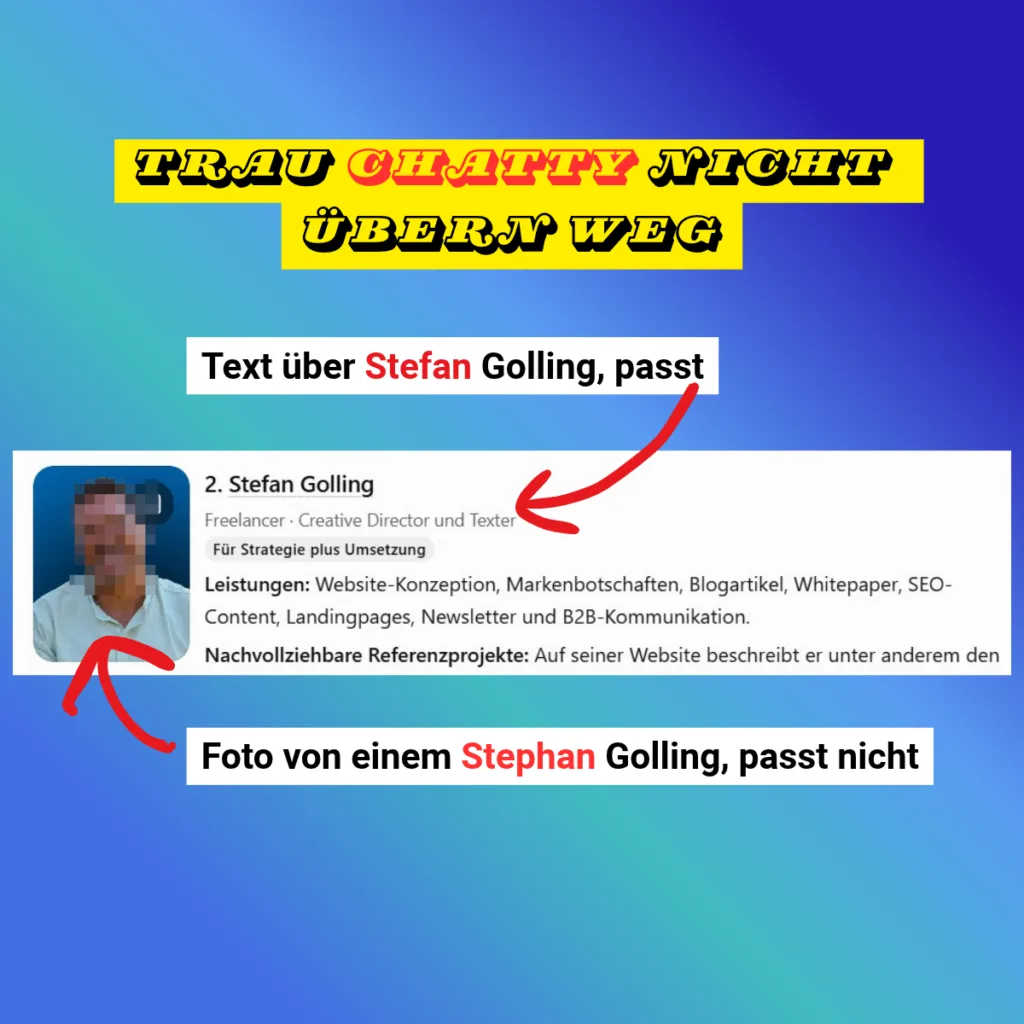
For example, without proper JSON-LD and clearly labelled images, ChatGPT might incorrectly attribute a photo of someone else to your brand. That’s what happened in the image below: ChatGPT lists me, Stefan Golling, Germany, and shows the photo of a Stephan from the US. Creepy, isn’t it? To prevent AI from spreading misinformation, you must be extremely precise in your technical setup.
4. Social & Multi-Channel Presence
AI models are fed by the entire web. A strong social media presence (LinkedIn, YouTube, TikTok, Facebook, Instagram etc.) signals relevance and timeliness to the AI. Brands that rely solely on traditional SEO risk losing out on the „live search“ capabilities of AI agents. By linking your various profiles through entity information, you help the AI understand and internalise your brand’s authority.
5. Measurement: The New Era of Monitoring
GEO success cannot be measured by clicks alone, as many AI responses do not send traditional referrer links. However, there are ways to track progress:
GEO success cannot be measured by clicks alone, as many AI responses do not send traditional referrer links. However, there are ways to track progress:
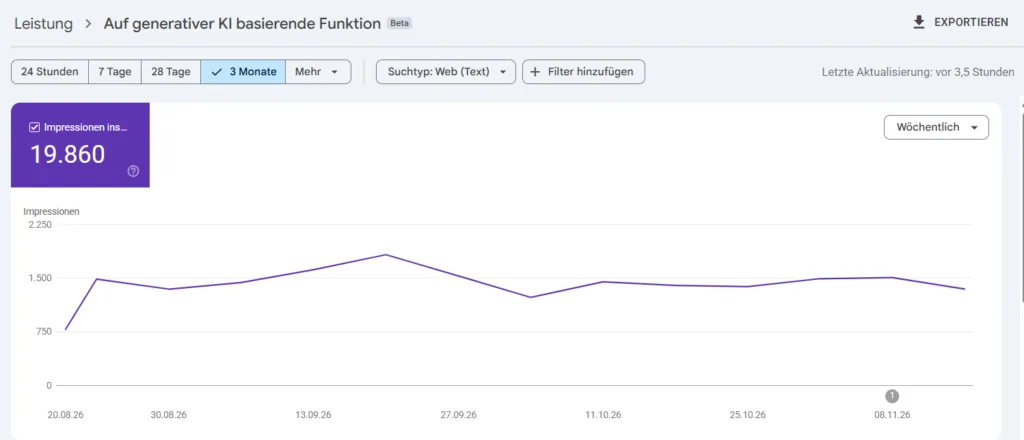
- Google Search Console: Watch for queries in „Natural Language“ (full questions). If you see people asking questions that lead to your site, you are ranking for those conversational terms. Below is an example for a longtail search term: Someone works as a Growth Marketing Manager and thinks that his brand’s identity is diluted in automated campaigns and asks for advice.

- UTM Tracking: Use UTM parameters for all links (PDFs, Newsletters, Social Media) to distinguish AI-driven traffic from standard „Direct“ traffic.
- Manual Prompt Testing: Regularly test ChatGPT or Perplexity to see how they evaluate your brand compared to your competitors.
- Analytics: Use tools like the ChatGPT Business Hub, GSC’s AI based performance stats (views only) or Semrush to monitor AI-driven visibility and „generative engine“ performance metrics.

- GEO: How to make your brand visible in ChatGPT, Perplexity & Google Gemini

- German Market Entry: What Goes Wrong and What To Do About It

- (Non-)AI Images: Labeling and Recognition – Content Credentials, SynthID & EU AI Icons

- How do LLMs „brains“ „work“: Tokens and Vektors visualised

- Longevity Marketing: How Brands and Customers Find Each Other

- Claude: What Can Anthropic’s AI Do?

- ChatGPT: Overview, use GPTs, alternatives

- Transcreation requires courage

- AI Consultant: What a professional can do for you

Conclusion: The Path to AI Visibility
Generic keyword optimisation is a thing of the past, and „AI Slop“ will not work in the long run. To embed your brand within AI models today, you must combine genuine subject matter expertise with machine-friendly technical architecture.
Ready to future-proof your brand for the AI era while strengthening your SEO? Book a consultation with a GEO expert today.